Welcome to the Profile page for

sonasingh_abab@yahoo.co.in

About sonasingh_abab@yahoo.co.in

  • Email: sonasingh_abab@yahoo.co.in
  • Nice Name: sonasingh_ababyahoo-co-in
  • Website: http://www.gillsir.com
  • Registered On :2024-07-20 12:24:54
  • Logged in as: sonasingh_abab@yahoo.co.in

sonasingh_abab@yahoo.co.in Posts

Are English language and Mother tongue competing our lives?


In many ways, English and one’s mother tongue (or native language) *can* compete in people’s lives, especially in a globalized world where English is often seen as the dominant language for business, technology, education, and even entertainment. This competition can create both opportunities and challenges, depending on the context and the individual’s situation.

### **How English and Mother Tongue Might Compete:**

1. **Language Shift and Identity:**

* In many communities, there’s a shift toward using English in daily life, sometimes at the expense of the mother tongue. This can lead to a gradual loss of native languages, especially in younger generations who may be more exposed to English through school, media, or the internet.
* When children learn English as their second language, they may begin to prioritize it, often because it feels more “global” or “useful” for career opportunities. This can sometimes lead to the diminishing importance of the mother tongue, especially if it’s not being actively spoken at home or in the community.
* On the flip side, for some people, their native language is a key part of their identity, culture, and sense of belonging. Losing or neglecting their mother tongue could feel like losing a connection to their heritage and family history.

2. **Bilingualism and Cognitive Load:**

* On a practical level, speaking both English and a mother tongue (especially in bilingual or multilingual societies) means constantly switching between languages. This “code-switching” can be mentally demanding, especially in fast-paced conversations or academic settings.
* Some people feel that they must choose one language for certain contexts (e.g., speaking English at work and the mother tongue at home) which can create a kind of internal conflict or pressure to “perform” in both languages.

3. **Language Learning and Skill Development:**

* Learning English can be seen as an economic advantage in many parts of the world, as it’s the language of international business, science, and technology. As a result, many students spend a lot of time learning English, sometimes at the expense of developing strong skills in their native language.
* In some cases, this can lead to “English dominance,” where people become fluent in English but lose proficiency in their first language over time, especially if English is used predominantly in school, work, or digital spaces.

4. **Social and Cultural Expectations:**

* In some societies, speaking English well is often associated with status, intelligence, or modernity. This can make individuals feel like they need to prioritize English, even if it comes at the cost of their cultural language.
* There can also be social pressure to “fit in” by adopting English in social media, education, or professional settings. This creates a situation where the mother tongue may be relegated to more informal or private spaces (like home or among close friends), while English takes precedence in public life.

### **Balancing Both Languages:**

While English and a mother tongue can sometimes “compete” for space in people’s lives, it’s possible to strike a balance between the two:

* **Language Preservation:** Many people actively work to preserve their mother tongue by teaching it to their children, using it in daily conversations, or even engaging in cultural activities that promote its use.
* **Bilingual Education:** In many parts of the world, bilingual education programs are designed to help students maintain fluency in both languages. This allows them to participate in global opportunities while also staying connected to their roots.
* **Cultural Celebrations:** In a world where English is dominant in the media, people often turn to music, literature, traditions, and festivals in their native language to keep it alive. This reinforces the importance of the mother tongue as a cultural asset, not just a means of communication.

### **English as a Global Connector:**

It’s also worth noting that English, while seen as a “global” language, is not necessarily replacing mother tongues everywhere. In fact, it often serves as a bridge language that enables people from different linguistic backgrounds to communicate with each other. Many people are multilingual, using English in one context (e.g., work or travel) and their mother tongue in another (e.g., at home or in their local community).

So, in a sense, English and a mother tongue don’t have to be in competition; they can coexist in ways that enrich a person’s life. The challenge is ensuring that both languages are valued and nurtured, rather than one being overshadowed by the other.


The term **”spoken English”** doesn’t have a single inventor or creator, as it’s more of a natural evolution of the English language itself.

However, the **concept** of spoken English as distinct from written English has evolved over time, largely influenced by linguistic development and the historical spread of English.

### Here’s a brief historical breakdown:

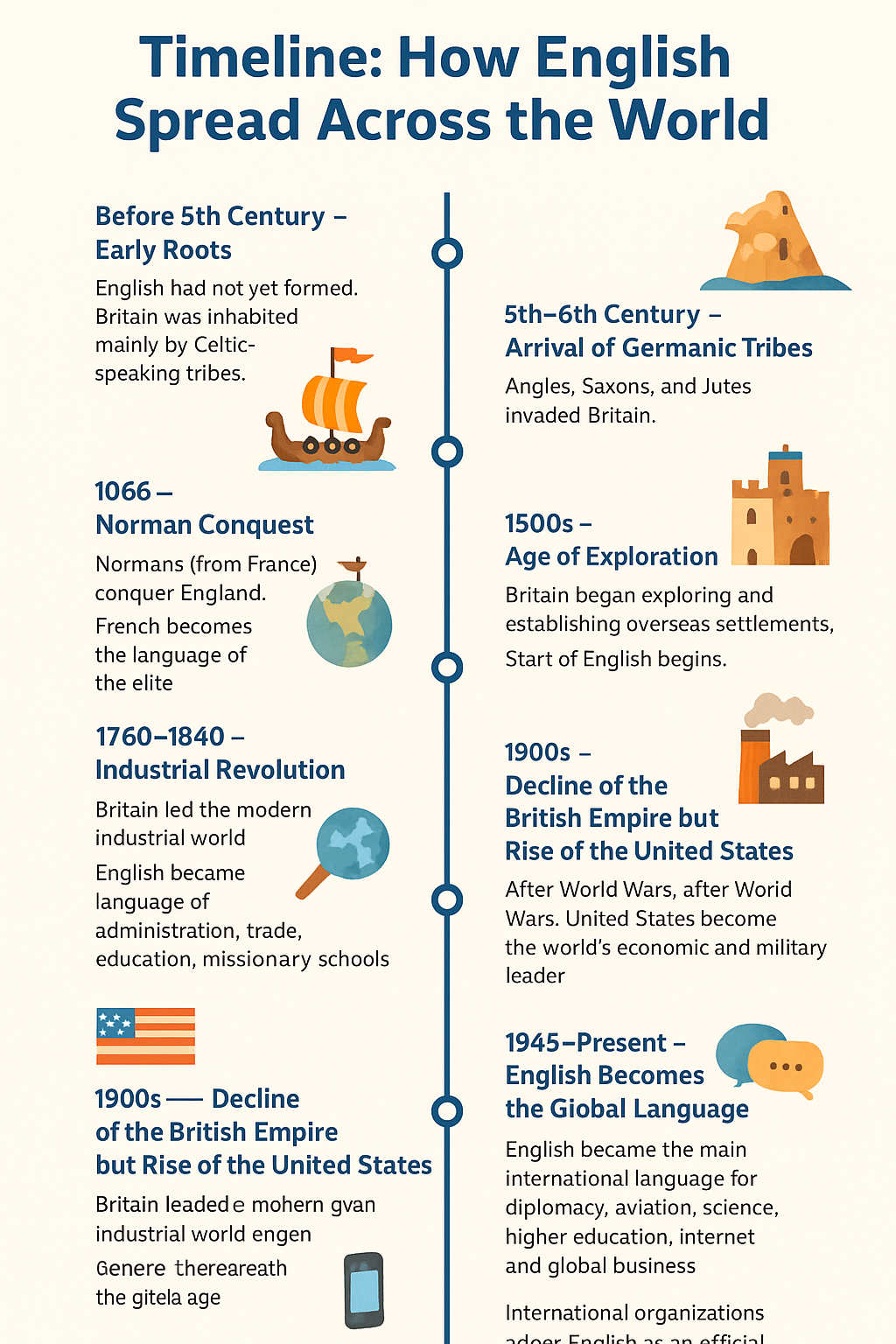
1. **Origins of English**: English itself originated from a mixture of Anglo-Saxon (Old English), Norman French, Latin, and other European languages, beginning in the early medieval period (around 5th to 12th centuries). In those early times, **spoken English** was the primary form of communication, as literacy rates were low and books were rare.

2. **The Rise of Literacy**: Written English started becoming more formalized in the 14th and 15th centuries, particularly with the spread of the **printing press** in the 15th century (thanks to Johannes Gutenberg). This is when written English began to be standardized, and distinctions between spoken and written forms of the language started to become more apparent.

3. **The Evolution of Spoken vs. Written Language**: By the 16th and 17th centuries, scholars and grammarians like **William Shakespeare** and **Samuel Johnson** were refining written English, which led to a divergence between spoken and written language forms. Spoken English was more flexible, informal, and regional, whereas written English became more standardized and structured, particularly in formal contexts.

### The Term Itself:

* **Spoken English** as a specific term likely became common as educational systems around the world began to formalize the teaching of English in the 19th and 20th centuries, particularly as English spread globally due to colonization and trade. The term was used to distinguish between the **spoken** and **written** forms of the language.
* It is difficult to pinpoint exactly when the term was first used, but it’s likely a natural progression of language development and teaching.

### Notable Figures in Language Development:

* **Noam Chomsky**, a 20th-century linguist, contributed significantly to the study of language, including spoken language, with his theories on grammar and syntax, though his focus was more on language structure rather than the specific term “spoken English.”
* **Henry Sweet**, an English philologist in the 19th century, was important in the study of phonetics (the sounds of spoken language) and was a key figure in the development of the understanding of spoken language.

In short, while **spoken English** as a term didn’t have a single inventor, the distinction between spoken and written English became clearer as the language evolved over centuries. The spread of English worldwide and the formalization of education likely contributed to the widespread use of the term.


Spoken English in Maninagar – Improve Your Fluency with Gill Sir

If you are looking for the best spoken English classes in Maninagar, Gill Sir offers expert coaching to help you develop strong communication skills. Whether you are a beginner or aiming for advanced fluency, our courses are designed to enhance your English proficiency for academic, professional, and everyday conversations.

Basic English vs. TOEFL English – What’s the Difference?
Basic English:
Focus: Everyday language, simple vocabulary, and fundamental grammar.

Purpose: Helps in daily communication and understanding common instructions.

Examples: “Hello,” “Thank you,” “Where is the market?”

TOEFL English:
Focus: Academic English with advanced vocabulary, complex grammar, and structured writing.

Purpose: Assesses English proficiency for higher education in English-speaking countries.

Examples: Understanding university lectures, reading academic papers, writing essays, and participating in discussions.
https://toeflcoaching.blogspot.com/2025/03/spoken-english-basic-english-vs-toefl.html

The guardian news speaks of Modi government calling English language colonial relic; because it feels that Bharitya people should come out of the trap of a mentality that is not going to help us.

Modi, it seems have taken the idea of Sri Aurobindo when he constantly says that we should come out of the colonial mindset. Sri Aurobindo Ashram has been publishing and publicizing the fact that colonial mindset has been detrimental of India in many ways.

https://www.theguardian.com/world/2022/oct/22/modi-employs-new-tool-in-indias-war-against-the-english-language-hindi-medical-degrees

Both CELPIP (Canadian English Language Proficiency Index Program) and IELTS (International English Language Testing System) are standardized tests designed to assess English proficiency. However, there are key differences between the two that can help determine which one is more suitable for you:

1. Purpose

  • CELPIP: Primarily designed for immigration, permanent residency, and citizenship applications in Canada. It evaluates functional English proficiency, focusing on day-to-day communication in Canadian settings.
  • IELTS: Widely accepted for immigration, university admissions, and employment purposes globally. It has two versions: IELTS Academic, used for higher education and professional registration, and IELTS General Training, used for immigration and work purposes.

2. Test Format

  • CELPIP: Completely computer-based, including all sections—listening, reading, writing, and speaking. Test-takers speak into a microphone for the speaking section, which is automatically recorded.
  • IELTS: Available in both computer-based and paper-based formats, but the speaking test is conducted face-to-face with an examiner, making it more personal.

3. Scoring System

  • CELPIP: Scores range from 1 to 12 for each section, with 12 being the highest proficiency level.
  • IELTS: Uses a 9-band scale for each section, with 9 representing an expert user of the language.

4. Accent and Vocabulary

  • CELPIP: Primarily uses Canadian English, so those more familiar with North American accents and vocabulary may find it easier to adapt.
  • IELTS: Uses a variety of accents, including American, Australian, and others, providing a more global language experience.

5. Test Length

  • CELPIP: The entire test takes about 3 hours in one sitting without any breaks between sections.
  • IELTS: The test also takes around 2 hours and 45 minutes, but the speaking section may be scheduled separately on a different day.

6. Availability

  • CELPIP: Available in fewer countries, mostly in Canada and some international locations where Canadian immigration is common.
  • IELTS: Available in over 140 countries, making it more accessible worldwide.

7. Ease of Test

  • CELPIP: Since it’s computer-based, some test-takers find it more convenient, especially for those who are comfortable with typing and speaking into a microphone. The test is also known to have straightforward questions compared to IELTS.
  • IELTS: The face-to-face speaking test may feel more intimidating to some, but it allows for natural interaction. The writing section in IELTS is done by hand (in paper-based versions), which might pose challenges to those who prefer typing.

8. Which to Choose?

  • CELPIP: Best for those specifically aiming for Canadian immigration or citizenship as it caters to Canadian English and contexts.
  • IELTS: More suitable for those seeking opportunities worldwide, including immigration to countries like the UK, Australia, and for academic admissions.

Both tests require solid preparation, but the choice between CELPIP and IELTS largely depends on your goals, test preference (computer vs. face-to-face), and the country where you intend to use the scores.