
IELTS – Complete Guide for IELTS Preparation in Ahmedabad
The International English Language Testing System (IELTS) is one of the world’s most recognized English language proficiency examinations for students, professionals, and immigration applicants. IELTS is accepted by universities, employers, and immigration authorities in countries such as Canada, Australia, the United Kingdom, and New Zealand.
Students in Ahmedabad preparing for study abroad opportunities often search for:
- IELTS coaching in Ahmedabad
- IELTS classes in Maninagar
- IELTS speaking practice
- IELTS preparation guidance
- IELTS Academic vs General Training
- IELTS mock tests
This complete IELTS guide explains:
- what IELTS is
- IELTS test format
- IELTS band scores
- IELTS preparation methods
- advantages and disadvantages of IELTS
- IELTS preparation tips for beginners
- IELTS coaching guidance in Ahmedabad
Whether you are planning to study abroad, migrate internationally, or improve your English communication skills, understanding IELTS properly is the first step toward global opportunities.
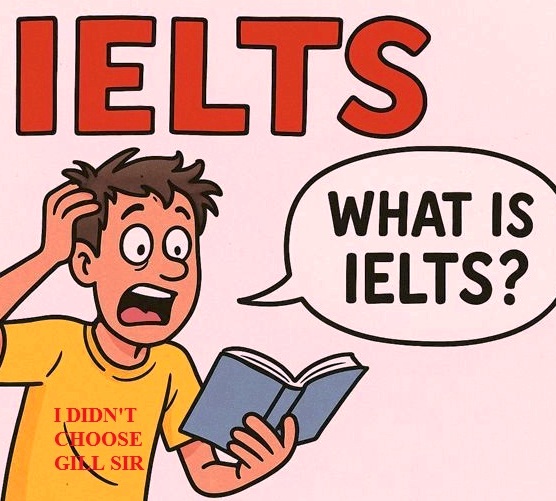
WHAT. IS. THE. IELTS?
The IELTS test — yes, the SAME test millions of students talk about, worry about, dream about — is not just an exam. It is a global benchmark. A gateway. A challenge that decides whether you are prepared to communicate confidently in an international environment.
This test, known as the International English Language Testing System, measures one important thing:
Can you communicate in REAL English — not shortcut English, not memorized English — but clear, practical, international English?
IELTS evaluates four major communication skills:
1. Listening
Can you understand spoken English accurately when people speak naturally?
2. Reading
Can you understand real-world information, academic texts, and written ideas without confusion?
3. Writing
Can you express thoughts logically, clearly, and grammatically?
4. Speaking
Can you communicate confidently when someone is evaluating your fluency, pronunciation, and vocabulary?
IELTS is not a pass-or-fail examination.
Students receive a band score from 0 to 9, and these scores influence opportunities related to:
- university admissions
- study abroad
- immigration
- work permits
- professional registration
Countries such as:
- Canada
- Australia
- the UK
- New Zealand
widely accept IELTS scores for education and migration purposes.
So, when someone asks:
“What is IELTS?”
The answer is simple:
IELTS is your opportunity to prove you can communicate with the world.
History of IELTS
IELTS was jointly developed in 1980 by:
- the British Council
- IDP Australia
- Cambridge Assessment English
The purpose was to create a fair and internationally recognized English language assessment system for:
- education
- migration
- professional communication
As international education expanded globally, IELTS gradually became one of the world’s most trusted English proficiency examinations.
Today, IELTS is accepted by:
- over 10,000 organizations
- universities
- immigration authorities
- multinational companies
across more than 140 countries.
👉 Read more about the evolution of IELTS:
Complete History of IELTS
Types of IELTS
Academic IELTS
Academic IELTS is designed for:
- university admissions
- higher education
- professional licensing
Students applying for international colleges and universities generally require Academic IELTS.
General Training IELTS
General IELTS is commonly used for:
- immigration
- work visas
- non-academic training
This version focuses more on practical communication skills used in daily life and workplace environments.
IELTS Band Score System
IELTS uses a band score system instead of pass or fail.
| Band Score | Skill Level |
|---|---|
| 9 | Expert User |
| 8 | Very Good User |
| 7 | Good User |
| 6 | Competent User |
| 5 | Modest User |
| 4 | Limited User |
Different universities and immigration programs require different minimum band scores.
What Is Expected From a Student in the IELTS Test?
If one were to distill the essence of the IELTS examination, it is fundamentally a linguistic test designed to evaluate whether a student can communicate effectively in an English-speaking environment.
The exam evaluates four interrelated abilities:
- listening
- reading
- writing
- speaking
Let us understand what IELTS expects from students in each module.
Listening – Attentiveness and Comprehension
The IELTS expects the candidate to listen carefully and understand both direct and indirect meaning.
Example:
“The train scheduled at 9:30 has been delayed to 10:10 due to engineering work.”
Students should understand:
- the revised timing
- the reason for delay
- the situation being described
Listening requires concentration and awareness.
Reading – Understanding Ideas and Meaning
IELTS Reading evaluates the ability to:
- analyze information
- understand arguments
- identify key ideas
- interpret meaning
Example:
“The migration pattern of Arctic terns is unparalleled in the avian world.”
Students should infer that Arctic terns travel unusually long distances compared to other birds.
The IELTS evaluates interpretation, not simple translation.
Writing – Clarity, Coherence, and Organization
IELTS Writing evaluates:
- grammar
- logical structure
- clarity of expression
- organization of ideas
Example essay topic:
“Do the benefits of studying abroad outweigh the drawbacks?”
A strong answer should contain:
- balanced arguments
- examples
- paragraph structure
- logical flow
IELTS expects communication, not memorization.
Speaking – Confidence and Natural Communication
IELTS Speaking evaluates fluency and communication confidence.
Students are not expected to speak artificially or use unnecessarily difficult vocabulary.
Example question:
“Describe a book you recently enjoyed.”
A natural answer could be:
“I recently read The Alchemist. I found it inspiring because it discusses following one’s dreams and personal growth.”
Simple, expressive, and natural communication is highly effective.
IELTS Test Format
Listening
- Duration: Approximately 30 minutes
- Audio conversations and lectures
- Concentration and note-taking required
Reading
- Duration: 60 minutes
- Academic or General passages
- Vocabulary and comprehension focus
Writing
- Duration: 60 minutes
- Task 1 and Task 2
- Essay writing and information analysis
Speaking
- Duration: 11–14 minutes
- Face-to-face interview
- Fluency and pronunciation evaluation
Pros and Cons of IELTS
IELTS should not merely be viewed as a stressful examination. It is also an opportunity to improve communication skills and prepare for international environments.
Advantages of IELTS
1. Gateway to Global Opportunities
IELTS opens pathways toward:
- international education
- global careers
- migration opportunities
It helps students move closer to their study abroad goals.
2. Real Communication Skills
IELTS develops practical English abilities useful in:
- universities
- workplaces
- international communication
3. International Recognition
Thousands of universities, organizations, and immigration systems trust IELTS globally.
4. Improves Confidence
Regular IELTS preparation improves:
- fluency
- vocabulary
- communication clarity
- speaking confidence
Challenges of IELTS
1. Stress and Nervousness
Many students feel pressure before the examination.
However, disciplined preparation reduces anxiety significantly.
2. Examination Fees
IELTS can be financially expensive for some families.
3. One Examination Day Matters
Performance on a single test day affects the final score.
4. Accent Challenges
Students sometimes struggle with unfamiliar accents during Listening sections.
However, practice gradually improves understanding.
Common IELTS Mistakes
Many students reduce their scores because of avoidable mistakes.
Memorizing Speaking Answers
Memorized responses sound unnatural.
Ignoring Time Management
Poor timing affects Reading and Writing performance.
Weak Vocabulary
Limited vocabulary reduces fluency and writing quality.
Lack of Speaking Practice
Many students study theory but avoid real communication practice.
IELTS Preparation Tips for Beginners
Practice English Daily
Regular communication improves fluency naturally.
Read English Newspapers and Articles
Reading improves:
- vocabulary
- grammar
- comprehension
Take Mock Tests
Mock tests help students:
- understand exam pressure
- improve speed
- identify weak areas
Improve Writing Gradually
Practice essay writing regularly using proper paragraph structure.
IELTS Preparation in Ahmedabad
Ahmedabad has become a major center for:
- IELTS coaching
- study abroad preparation
- Spoken English training
Students from:
actively prepare for IELTS for:
- Canada study visas
- Australian migration
- UK education
- international careers
Students often look for:
- beginner-friendly IELTS coaching
- speaking practice
- mock tests
- writing guidance
- communication improvement
IELTS Coaching and Preparation Resources
Explore more IELTS preparation resources:
- Gill Sir IELTS Classes in Ahmedabad
- Free IELTS Demo Class
- Free IELTS Classes in Ahmedabad
- IELTS Coaching in Vatva
- History of IELTS
IELTS Test Flowchart – Step-by-Step Process
Step 1 – Register for IELTS
Create an account and choose:
- Academic IELTS
- General Training IELTS
Step 2 – Prepare for IELTS
Study using:
- mock tests
- speaking practice
- vocabulary improvement
- writing exercises
Step 3 – Attend the IELTS Exam
Complete:
- Listening
- Reading
- Writing
- Speaking modules
Step 4 – Receive Your Band Score
Results are usually available within a few days depending on test format.
Step 5 – Apply for Universities or Visa
Use IELTS scores for:
- university applications
- immigration
- professional opportunities
Frequently Asked Questions About IELTS
What is IELTS used for?
IELTS is used for:
- study abroad
- immigration
- work permits
- professional registration
Is IELTS difficult for beginners?
With proper preparation and regular speaking practice, beginners can prepare successfully.
Which IELTS is required for Canada?
Both Academic and General IELTS are used depending on:
- study purpose
- immigration category
How long is IELTS valid?
IELTS scores are generally valid for two years.
What is a good IELTS score?
Band requirements vary depending on universities and immigration programs.
Can Gujarati-medium students prepare for IELTS?
Yes. With regular communication practice and proper guidance, Gujarati-medium students can achieve strong IELTS scores.
Conclusion
IELTS is more than an English examination. It is a global communication benchmark that helps students, professionals, and immigrants pursue international opportunities.
From Listening and Reading to Writing and Speaking, IELTS evaluates practical communication abilities necessary for success in international environments.
For students in Ahmedabad and Gujarat, IELTS preparation has become an important pathway toward:
- study abroad goals
- migration opportunities
- global careers
- communication improvement
With proper preparation, regular speaking practice, mock tests, and communication development, students can confidently prepare for IELTS and move closer toward international success.
Planning to prepare for IELTS in Ahmedabad?
Explore beginner-friendly IELTS coaching, speaking practice, mock tests, and communication support at: