Who and What laid the foundations of Spoken English?
The person most commonly considered the **“Father of the English language”** is **Geoffrey Chaucer**.
—
# **Why is Geoffrey Chaucer called the Father of English?**
### **1. He wrote major literature in English when most writers used Latin or French**
During the 1300s, educated writing in England was mostly in:
* **Latin** (for scholars and the Church)
* **French** (used by the royal court)
Chaucer broke this tradition and chose to write in **Middle English**, making English a respected language for literature.
—
### **2. He shaped the development of Middle English**
Chaucer’s works, especially *The Canterbury Tales*, helped:
* Standardize grammar
* Spread new vocabulary
* Create a common literary style
His influence made English more recognizable and structured.
—
### **3. He made English a language of culture and storytelling**
Before Chaucer, English wasn’t seen as “prestigious.”
Chaucer’s writing:
* Reached ordinary people
* Showed English could be poetic and expressive
* Elevated English to a **literary language**
—
### **4. His works influenced later writers**
Chaucer inspired:
* Shakespeare
* Spenser
* Milton
* And many later English poets
His style shaped the future of English literature.
Geoffrey Chaucer is considered the Father of English because he used English for major literary works at a time when most wrote in Latin or French, helping to standardize and elevate the English language.
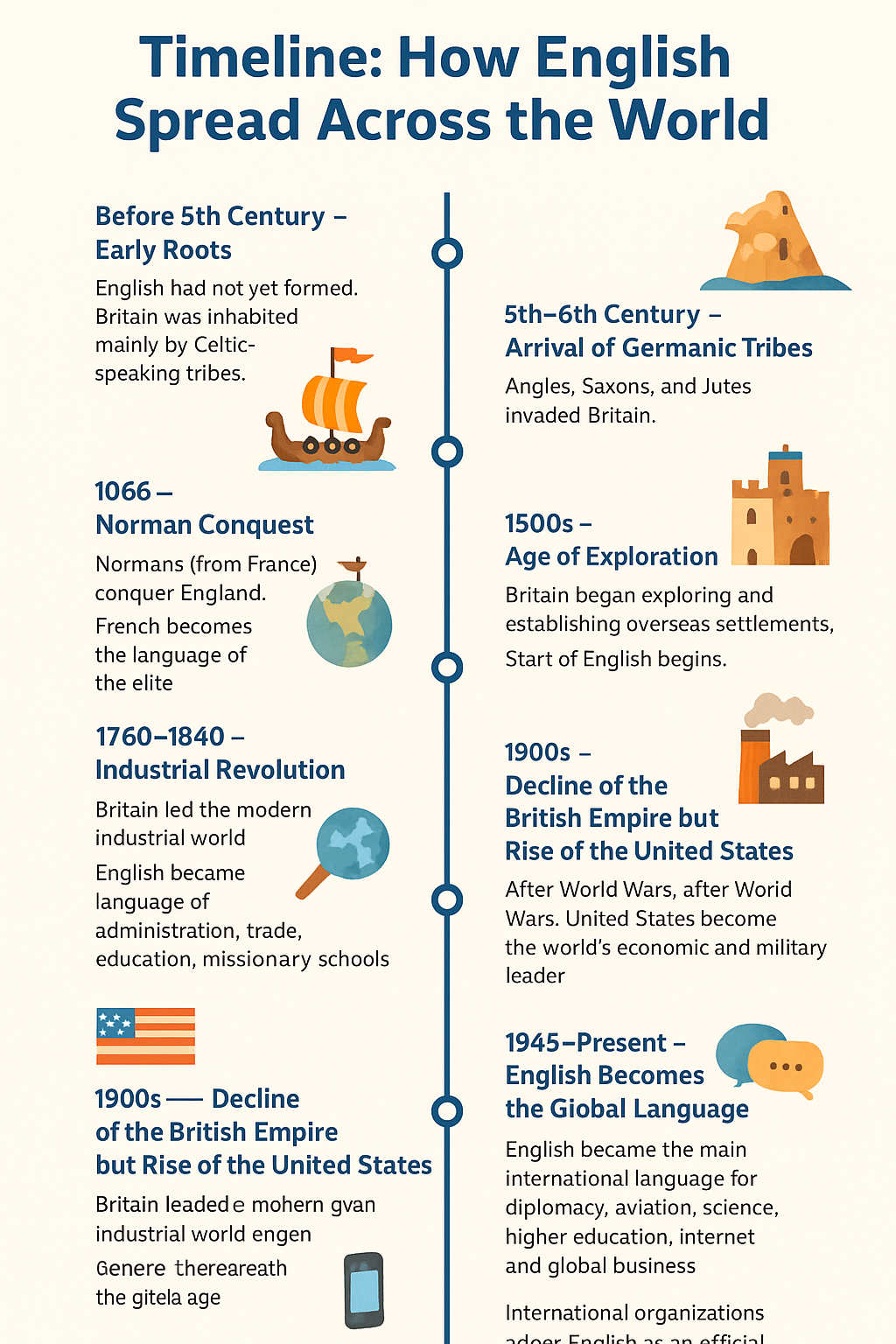
[caption id="attachment_11758" align="alignnone" width="1024"] history and timeline of english[/caption]
English as dominant language in world and its timeline
English became dominant across the world due to a combination of **historical, political, economic, and cultural factors**, not because it is inherently better than any other language. Here are the main reasons:
### **1. British Colonization**
* From the 1600s to the early 1900s, the **British Empire** expanded across Asia, Africa, North America, Australia, and the Caribbean.
* Wherever the British ruled, they established English in government, education, law, and trade.
* At its peak, the British Empire controlled about **25% of the world**, spreading English widely.
### **2. Industrial Revolution**
* Britain led the **Industrial Revolution**, becoming a global center for science, technology, and trade.
* Many innovations, research, and technical documents were produced in English, making it a language of progress.
### **3. Rise of the United States**
* After World War II, the **USA became the world’s leading economic, military, and technological power**.
* American influence in business, movies, music, aviation, computing, and the internet strengthened the global use of English.
* Multinational companies (Google, Microsoft, Coca-Cola, etc.) operate largely in English.
### **4. Globalization and International Communication**
* English became the **common language** for international trade, diplomacy, travel, science, and entertainment.
* It is now the **official or working language** of the United Nations, NATO, the European Union, and global airlines.
### **5. Education and Opportunity**
* People around the world study English because it opens doors to **jobs, higher education, migration, and global networking**.
* English-language media—Hollywood movies, pop songs, social media—also make it more popular.
### **6. Internet and Technology**
* A large portion of early internet content was in English.
* Programming languages and tech documentation are mostly English-based, making it the “default” language of the digital age.
---
English didn’t become dominant by chance—it spread through **colonial power (Britain), global influence (USA), technology, trade, and culture**.
English Time Line
---
## **📘 Timeline: How English Spread Across the World**
### **1. Before 5th Century – Early Roots**
* English had not yet formed. Britain was inhabited mainly by Celtic-speaking tribes.
---
### **2. 5th–6th Century – Arrival of Germanic Tribes**
* **Angles, Saxons, and Jutes** invade Britain.
* Their languages blend to form **Old English**, the earliest form of English.
---
### **3. 1066 – Norman Conquest**
* The Normans (from France) conquer England.
* French becomes the language of the elite; Old English mixes with Norman French.
* This creates **Middle English**.
---
### **4. 1500s – Age of Exploration**
* Britain begins exploring and establishing overseas settlements.
* Start of English being carried abroad.
* Transition into **Early Modern English** (Shakespeare’s time).
---
### **5. 1600s–1800s – British Empire Expands**
* English spreads to **North America, Caribbean, Africa, Asia, and Australia**.
* Becomes a language of:
* Administration
* Trade
* Education
* Missionary schools
* “The sun never sets on the British Empire.”
---
### **6. 1760–1840 – Industrial Revolution**
* Britain leads the modern industrial world.
* English becomes the language of:
* Science
* Engineering
* Manufacturing
* Global trade
---
### **7. 1900s – Decline of the British Empire but Rise of the United States**
* After World Wars, Britain’s power decreases.
* The **United States becomes the world’s economic and military leader**.
* American influence spreads English through:
* Movies (Hollywood)
* Music (pop, rock, jazz)
* Technology
* Business
---
### **8. 1945–Present – English Becomes the Global Language**
* English becomes the **main international language** for:
* Diplomacy
* Aviation
* Science
* Higher education
* Internet
* Global business
* International organizations (UN, NATO, EU) adopt English as an official language.
---
### **9. 1990s–Today – Digital Age**
* Internet, software, smartphones, and AI grow mostly in English.
* Most coding languages use English-based keywords.
* English becomes the **default global communication tool**.
---
From **Germanic origins** → **mixing with French** → **British colonial expansion** → **American influence and technology**, English gradually rose to become the world’s most widely learned language.
---
English as dominant language in world and its timeline
English became dominant across the world due to a combination of **historical, political, economic, and cultural factors**, not because it is inherently better than any other language. Here are the main reasons:
### **1. British Colonization**
* From the 1600s to the early 1900s, the **British Empire** expanded across Asia, Africa, North America, Australia, and the Caribbean.
* Wherever the British ruled, they established English in government, education, law, and trade.
* At its peak, the British Empire controlled about **25% of the world**, spreading English widely.
### **2. Industrial Revolution**
* Britain led the **Industrial Revolution**, becoming a global center for science, technology, and trade.
* Many innovations, research, and technical documents were produced in English, making it a language of progress.
### **3. Rise of the United States**
* After World War II, the **USA became the world’s leading economic, military, and technological power**.
* American influence in business, movies, music, aviation, computing, and the internet strengthened the global use of English.
* Multinational companies (Google, Microsoft, Coca-Cola, etc.) operate largely in English.
### **4. Globalization and International Communication**
* English became the **common language** for international trade, diplomacy, travel, science, and entertainment.
* It is now the **official or working language** of the United Nations, NATO, the European Union, and global airlines.
### **5. Education and Opportunity**
* People around the world study English because it opens doors to **jobs, higher education, migration, and global networking**.
* English-language media—Hollywood movies, pop songs, social media—also make it more popular.
### **6. Internet and Technology**
* A large portion of early internet content was in English.
* Programming languages and tech documentation are mostly English-based, making it the “default” language of the digital age.
—
English didn’t become dominant by chance—it spread through **colonial power (Britain), global influence (USA), technology, trade, and culture**.
English Time Line
—
## **📘 Timeline: How English Spread Across the World**
### **1. Before 5th Century – Early Roots**
* English had not yet formed. Britain was inhabited mainly by Celtic-speaking tribes.
—
### **2. 5th–6th Century – Arrival of Germanic Tribes**
* **Angles, Saxons, and Jutes** invade Britain.
* Their languages blend to form **Old English**, the earliest form of English.
—
### **3. 1066 – Norman Conquest**
* The Normans (from France) conquer England.
* French becomes the language of the elite; Old English mixes with Norman French.
* This creates **Middle English**.
—
### **4. 1500s – Age of Exploration**
* Britain begins exploring and establishing overseas settlements.
* Start of English being carried abroad.
* Transition into **Early Modern English** (Shakespeare’s time).
—
### **5. 1600s–1800s – British Empire Expands**
* English spreads to **North America, Caribbean, Africa, Asia, and Australia**.
* Becomes a language of:
* Administration
* Trade
* Education
* Missionary schools
* “The sun never sets on the British Empire.”
—
### **6. 1760–1840 – Industrial Revolution**
* Britain leads the modern industrial world.
* English becomes the language of:
* Science
* Engineering
* Manufacturing
* Global trade
—
### **7. 1900s – Decline of the British Empire but Rise of the United States**
* After World Wars, Britain’s power decreases.
* The **United States becomes the world’s economic and military leader**.
* American influence spreads English through:
* Movies (Hollywood)
* Music (pop, rock, jazz)
* Technology
* Business
—
### **8. 1945–Present – English Becomes the Global Language**
* English becomes the **main international language** for:
* Diplomacy
* Aviation
* Science
* Higher education
* Internet
* Global business
* International organizations (UN, NATO, EU) adopt English as an official language.
—
### **9. 1990s–Today – Digital Age**
* Internet, software, smartphones, and AI grow mostly in English.
* Most coding languages use English-based keywords.
* English becomes the **default global communication tool**.
—
From **Germanic origins** → **mixing with French** → **British colonial expansion** → **American influence and technology**, English gradually rose to become the world’s most widely learned language.
In many ways, English and one’s mother tongue (or native language) *can* compete in people’s lives, especially in a globalized world where English is often seen as the dominant language for business, technology, education, and even entertainment. This competition can create both opportunities and challenges, depending on the context and the individual’s situation.
### **How English and Mother Tongue Might Compete:**
1. **Language Shift and Identity:**
* In many communities, there’s a shift toward using English in daily life, sometimes at the expense of the mother tongue. This can lead to a gradual loss of native languages, especially in younger generations who may be more exposed to English through school, media, or the internet.
* When children learn English as their second language, they may begin to prioritize it, often because it feels more “global” or “useful” for career opportunities. This can sometimes lead to the diminishing importance of the mother tongue, especially if it’s not being actively spoken at home or in the community.
* On the flip side, for some people, their native language is a key part of their identity, culture, and sense of belonging. Losing or neglecting their mother tongue could feel like losing a connection to their heritage and family history.
2. **Bilingualism and Cognitive Load:**
* On a practical level, speaking both English and a mother tongue (especially in bilingual or multilingual societies) means constantly switching between languages. This “code-switching” can be mentally demanding, especially in fast-paced conversations or academic settings.
* Some people feel that they must choose one language for certain contexts (e.g., speaking English at work and the mother tongue at home) which can create a kind of internal conflict or pressure to “perform” in both languages.
3. **Language Learning and Skill Development:**
* Learning English can be seen as an economic advantage in many parts of the world, as it’s the language of international business, science, and technology. As a result, many students spend a lot of time learning English, sometimes at the expense of developing strong skills in their native language.
* In some cases, this can lead to “English dominance,” where people become fluent in English but lose proficiency in their first language over time, especially if English is used predominantly in school, work, or digital spaces.
4. **Social and Cultural Expectations:**
* In some societies, speaking English well is often associated with status, intelligence, or modernity. This can make individuals feel like they need to prioritize English, even if it comes at the cost of their cultural language.
* There can also be social pressure to “fit in” by adopting English in social media, education, or professional settings. This creates a situation where the mother tongue may be relegated to more informal or private spaces (like home or among close friends), while English takes precedence in public life.
### **Balancing Both Languages:**
While English and a mother tongue can sometimes “compete” for space in people’s lives, it’s possible to strike a balance between the two:
* **Language Preservation:** Many people actively work to preserve their mother tongue by teaching it to their children, using it in daily conversations, or even engaging in cultural activities that promote its use.
* **Bilingual Education:** In many parts of the world, bilingual education programs are designed to help students maintain fluency in both languages. This allows them to participate in global opportunities while also staying connected to their roots.
* **Cultural Celebrations:** In a world where English is dominant in the media, people often turn to music, literature, traditions, and festivals in their native language to keep it alive. This reinforces the importance of the mother tongue as a cultural asset, not just a means of communication.
### **English as a Global Connector:**
It’s also worth noting that English, while seen as a “global” language, is not necessarily replacing mother tongues everywhere. In fact, it often serves as a bridge language that enables people from different linguistic backgrounds to communicate with each other. Many people are multilingual, using English in one context (e.g., work or travel) and their mother tongue in another (e.g., at home or in their local community).
So, in a sense, English and a mother tongue don’t have to be in competition; they can coexist in ways that enrich a person’s life. The challenge is ensuring that both languages are valued and nurtured, rather than one being overshadowed by the other.
The term **”spoken English”** doesn’t have a single inventor or creator, as it’s more of a natural evolution of the Englishlanguage itself. However, the **concept** of spoken English as distinct from written English has evolved over time, largely influenced by linguistic development and the historical spread of English.
### Here’s a brief historical breakdown:
1. **Origins of English**: English itself originated from a mixture of Anglo-Saxon (Old English), Norman French, Latin, and other European languages, beginning in the early medieval period (around 5th to 12th centuries). In those early times, **spoken English** was the primary form of communication, as literacy rates were low and books were rare.
2. **The Rise of Literacy**: Written English started becoming more formalized in the 14th and 15th centuries, particularly with the spread of the **printing press** in the 15th century (thanks to Johannes Gutenberg). This is when written English began to be standardized, and distinctions between spoken and written forms of the language started to become more apparent.
3. **The Evolution of Spoken vs. Written Language**: By the 16th and 17th centuries, scholars and grammarians like **William Shakespeare** and **Samuel Johnson** were refining written English, which led to a divergence between spoken and written language forms. Spoken English was more flexible, informal, and regional, whereas written English became more standardized and structured, particularly in formal contexts.
### The Term Itself:
* **Spoken English** as a specific term likely became common as educational systems around the world began to formalize the teaching of English in the 19th and 20th centuries, particularly as English spread globally due to colonization and trade. The term was used to distinguish between the **spoken** and **written** forms of the language.
* It is difficult to pinpoint exactly when the term was first used, but it’s likely a natural progression of language development and teaching.
### Notable Figures in Language Development:
* **Noam Chomsky**, a 20th-century linguist, contributed significantly to the study of language, including spoken language, with his theories on grammar and syntax, though his focus was more on language structure rather than the specific term “spoken English.”
* **Henry Sweet**, an English philologist in the 19th century, was important in the study of phonetics (the sounds of spoken language) and was a key figure in the development of the understanding of spoken language.
In short, while **spoken English** as a term didn’t have a single inventor, the distinction between spoken and written English became clearer as the language evolved over centuries. The spread of English worldwide and the formalization of education likely contributed to the widespread use of the term.
If you are looking for the best spoken English classes in Maninagar, Gill Sir offers expert coaching to help you develop strong communication skills. Whether you are a beginner or aiming for advanced fluency, our courses are designed to enhance your English proficiency for academic, professional, and everyday conversations.
Basic English vs. TOEFL English – What’s the Difference?
Basic English:
Focus: Everyday language, simple vocabulary, and fundamental grammar.
Purpose: Helps in daily communication and understanding common instructions.
Examples: “Hello,” “Thank you,” “Where is the market?”
TOEFL English:
Focus: Academic English with advanced vocabulary, complex grammar, and structured writing.
Purpose: Assesses English proficiency for higher education in English-speaking countries.
The guardian news speaks of Modi government calling Englishlanguage colonial relic; because it feels that Bharitya people should come out of the trap of a mentality that is not going to help us.
Modi, it seems have taken the idea of Sri Aurobindo when he constantly says that we should come out of the colonial mindset. Sri Aurobindo Ashram has been publishing and publicizing the fact that colonial mindset has been detrimental of India in many ways.
Learning English is highly beneficial for several reasons, and it holds a significant place in today’s globalized world. Here are some of the benefits of learning English, reasons for its importance, tips for choosing a spoken English institute, and potential career opportunities after mastering the language:
Global Communication: English is one of the most widely spoken languages globally, and it serves as a lingua franca for people from diverse linguistic backgrounds. Learning English enables you to communicate with people from different countries and cultures.
Access to Information: A significant amount of information on the internet, including academic resources, research papers, and websites, is available in English. Learning English allows you to access a vast repository of knowledge.
Business and Career Opportunities: English is the language of international business and commerce. Many multinational companies use English as their official language, so proficiency in English can enhance your career prospects and open up global job opportunities.
Travel and Tourism: English is widely used in the tourism industry. When traveling to English-speaking countries or popular tourist destinations, knowing English can make your journey more enjoyable and convenient.
Education: Many top universities and educational institutions around the world offer courses in English. Learning English is essential for students who plan to study abroad or pursue higher education in English-speaking countries.
Why English is Important Today:
Globalization: English is the language of globalization. It facilitates communication and collaboration across borders in various fields, including business, technology, science, and culture.
Internet and Media: Much of the content on the internet, as well as movies, TV shows, and music, is in English. Understanding English allows you to access a wide range of entertainment and information.
Science and Technology: English is the dominant language in the fields of science, technology, and innovation. Learning English is crucial for staying updated with the latest developments and research.
Diplomacy and International Relations: English is the primary language used in diplomacy and international negotiations. Proficiency in English is essential for diplomats and those involved in global politics.
Choosing a Spoken English Institute:
When selecting a spoken English institute, consider the following factors:
Reputation: Look for institutes with a good reputation for teaching English. Read reviews, ask for recommendations, and check their success stories.
Qualified Instructors: Ensure that the institute has experienced and qualified instructors who can provide effective language instruction.
Course Content: Review the course curriculum to see if it aligns with your goals. The institute should offer courses suitable for your skill level, whether you’re a beginner or advanced learner.
Teaching Methodology: Inquire about the teaching methods and materials used. A combination of listening, speaking, reading, and writing activities is essential for comprehensive language learning.
Flexibility: Consider the flexibility of class schedules and the availability of online or offline options, depending on your needs.
Career Opportunities after Learning English:
Proficiency in English can significantly expand your career opportunities:
International Business: You can work for multinational corporations, where English is often the primary language of communication.
Translation and Interpretation: Become a professional translator or interpreter, helping bridge language gaps in various industries.
Tourism and Hospitality: Work in the tourism and hospitality sector, where English-speaking tourists are common.
Teaching English: Consider becoming an English language teacher, either in your home country or abroad.
Content Creation: Opportunities in content writing, blogging, or digital marketing are often more accessible for English speakers.
Global NGOs and International Organizations: Many international organizations and non-governmental organizations (NGOs) require English-speaking professionals for their operations and projects.
In conclusion, learning English offers numerous personal, professional, and academic advantages in our interconnected world. Choosing a reputable institute and investing in your English language skills can open doors to a wide range of career opportunities and enrich your overall life experiences.
Booking an IELTS (International EnglishLanguage Testing System) test date typically involves several steps. Here’s a general guide on how to book an IELTS test date:
Check Eligibility: Ensure you meet the eligibility requirements for taking the IELTS test, such as the purpose of taking the test (academic or general training) and any specific requirements set by the institution or organization you’re applying to.
Decide on the Test Type: Determine whether you need the Academic or General Training module of the IELTS. The Academic module is typically for those planning to study at a university, while the General Training module is often used for immigration or work purposes.
Find a Test Center: Visit the official IELTS website (https://www.ielts.org/) and use the “Find a Test Location” tool to locate a test center near you. You can choose a location that is convenient for you.
Check Test Dates and Availability: After selecting a test center, check the available test dates. IELTS exams are usually conducted multiple times a month, so you should be able to find a suitable date.
Register Online: Most test centers offer online registration. You can complete the registration process on the official IELTS website or the website of the test center you’ve selected. You’ll need to provide personal information, including your identification details and contact information.
Pay the Test Fee: Pay the required test fee when registering. The fee can vary depending on your location and the test center. Make sure to check the fees before booking.
Upload a Photo: You may be required to upload a recent passport-sized photo during the registration process. Ensure your photo meets the specified requirements.
Receive Confirmation: After completing the registration and payment, you’ll receive a confirmation email with details about your test date, time, and location. Keep this email safe, as you’ll need it on test day.
Prepare for the Test: Before your test date, make sure to adequately prepare for the IELTS exam. You can use official IELTS preparation materials or consider taking a preparatory course.
Attend the Test: On the test day, arrive at the test center with your identification documents, such as a valid passport or national ID card, and the confirmation email.
Remember that the specific process and requirements may vary slightly depending on your location and the test center you choose, so it’s essential to check the official IELTS website or contact the chosen test center for the most up-to-date and accurate information. It’s also advisable to book your test well in advance to secure your preferred date and time.

 history and timeline of english[/caption]
