Who and What laid the foundations of Spoken English?
The person most commonly considered the **“Father of the English language”** is **Geoffrey Chaucer**.
—
# **Why is Geoffrey Chaucer called the Father of English?**
### **1. He wrote major literature in English when most writers used Latin or French**
During the 1300s, educated writing in England was mostly in:
* **Latin** (for scholars and the Church)
* **French** (used by the royal court)
Chaucer broke this tradition and chose to write in **Middle English**, making English a respected language for literature.
—
### **2. He shaped the development of Middle English**
Chaucer’s works, especially *The Canterbury Tales*, helped:
* Standardize grammar
* Spread new vocabulary
* Create a common literary style
His influence made English more recognizable and structured.
—
### **3. He made English a language of culture and storytelling**
Before Chaucer, English wasn’t seen as “prestigious.”
Chaucer’s writing:
* Reached ordinary people
* Showed English could be poetic and expressive
* Elevated English to a **literary language**
—
### **4. His works influenced later writers**
Chaucer inspired:
* Shakespeare
* Spenser
* Milton
* And many later English poets
His style shaped the future of English literature.
Geoffrey Chaucer is considered the Father of English because he used English for major literary works at a time when most wrote in Latin or French, helping to standardize and elevate the English language.
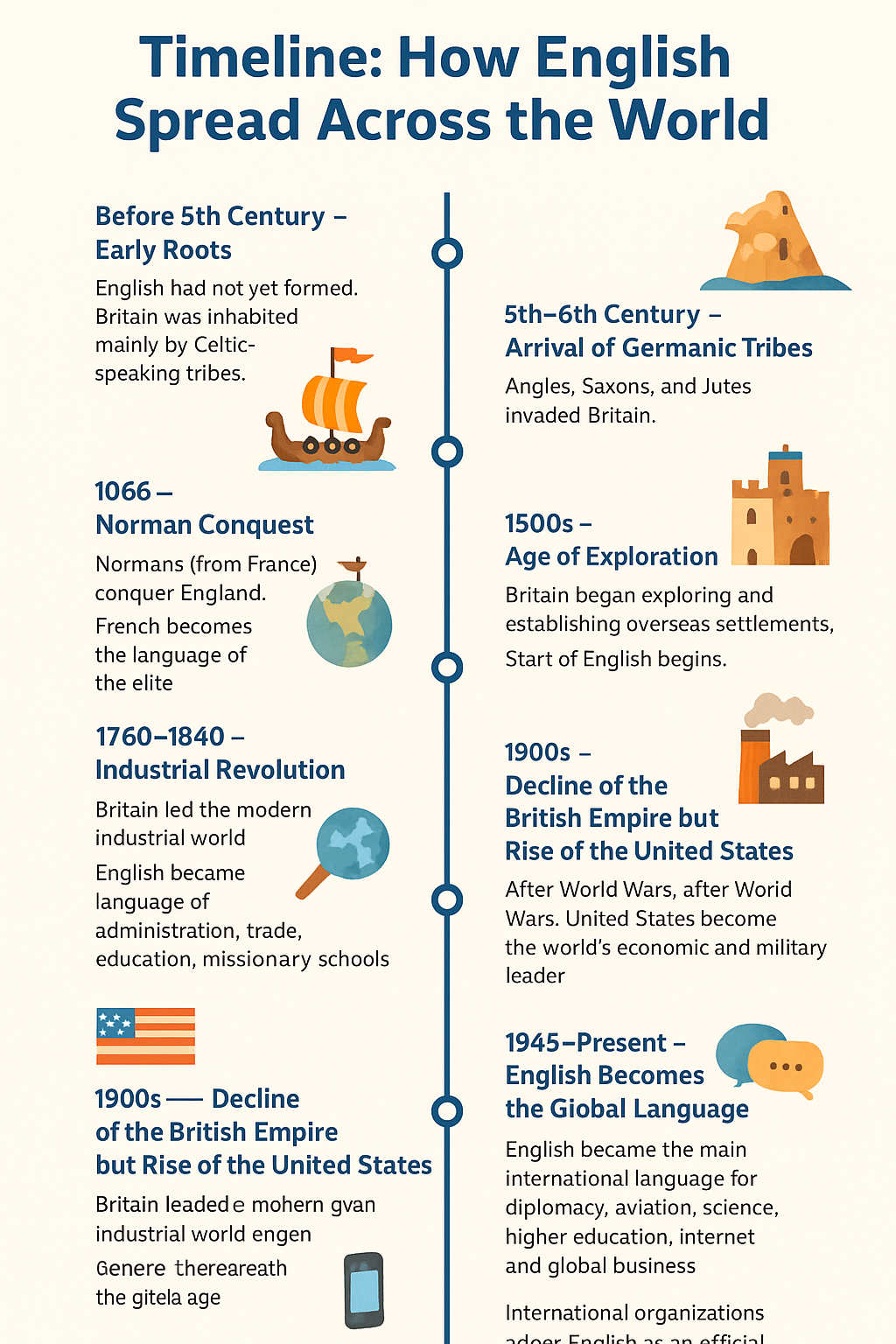
[caption id="attachment_11758" align="alignnone" width="1024"] history and timeline of english[/caption]
English as dominant language in world and its timeline
English became dominant across the world due to a combination of **historical, political, economic, and cultural factors**, not because it is inherently better than any other language. Here are the main reasons:
### **1. British Colonization**
* From the 1600s to the early 1900s, the **British Empire** expanded across Asia, Africa, North America, Australia, and the Caribbean.
* Wherever the British ruled, they established English in government, education, law, and trade.
* At its peak, the British Empire controlled about **25% of the world**, spreading English widely.
### **2. Industrial Revolution**
* Britain led the **Industrial Revolution**, becoming a global center for science, technology, and trade.
* Many innovations, research, and technical documents were produced in English, making it a language of progress.
### **3. Rise of the United States**
* After World War II, the **USA became the world’s leading economic, military, and technological power**.
* American influence in business, movies, music, aviation, computing, and the internet strengthened the global use of English.
* Multinational companies (Google, Microsoft, Coca-Cola, etc.) operate largely in English.
### **4. Globalization and International Communication**
* English became the **common language** for international trade, diplomacy, travel, science, and entertainment.
* It is now the **official or working language** of the United Nations, NATO, the European Union, and global airlines.
### **5. Education and Opportunity**
* People around the world study English because it opens doors to **jobs, higher education, migration, and global networking**.
* English-language media—Hollywood movies, pop songs, social media—also make it more popular.
### **6. Internet and Technology**
* A large portion of early internet content was in English.
* Programming languages and tech documentation are mostly English-based, making it the “default” language of the digital age.
---
English didn’t become dominant by chance—it spread through **colonial power (Britain), global influence (USA), technology, trade, and culture**.
English Time Line
---
## **📘 Timeline: How English Spread Across the World**
### **1. Before 5th Century – Early Roots**
* English had not yet formed. Britain was inhabited mainly by Celtic-speaking tribes.
---
### **2. 5th–6th Century – Arrival of Germanic Tribes**
* **Angles, Saxons, and Jutes** invade Britain.
* Their languages blend to form **Old English**, the earliest form of English.
---
### **3. 1066 – Norman Conquest**
* The Normans (from France) conquer England.
* French becomes the language of the elite; Old English mixes with Norman French.
* This creates **Middle English**.
---
### **4. 1500s – Age of Exploration**
* Britain begins exploring and establishing overseas settlements.
* Start of English being carried abroad.
* Transition into **Early Modern English** (Shakespeare’s time).
---
### **5. 1600s–1800s – British Empire Expands**
* English spreads to **North America, Caribbean, Africa, Asia, and Australia**.
* Becomes a language of:
* Administration
* Trade
* Education
* Missionary schools
* “The sun never sets on the British Empire.”
---
### **6. 1760–1840 – Industrial Revolution**
* Britain leads the modern industrial world.
* English becomes the language of:
* Science
* Engineering
* Manufacturing
* Global trade
---
### **7. 1900s – Decline of the British Empire but Rise of the United States**
* After World Wars, Britain’s power decreases.
* The **United States becomes the world’s economic and military leader**.
* American influence spreads English through:
* Movies (Hollywood)
* Music (pop, rock, jazz)
* Technology
* Business
---
### **8. 1945–Present – English Becomes the Global Language**
* English becomes the **main international language** for:
* Diplomacy
* Aviation
* Science
* Higher education
* Internet
* Global business
* International organizations (UN, NATO, EU) adopt English as an official language.
---
### **9. 1990s–Today – Digital Age**
* Internet, software, smartphones, and AI grow mostly in English.
* Most coding languages use English-based keywords.
* English becomes the **default global communication tool**.
---
From **Germanic origins** → **mixing with French** → **British colonial expansion** → **American influence and technology**, English gradually rose to become the world’s most widely learned language.
---
English as dominant language in world and its timeline
English became dominant across the world due to a combination of **historical, political, economic, and cultural factors**, not because it is inherently better than any other language. Here are the main reasons:
### **1. British Colonization**
* From the 1600s to the early 1900s, the **British Empire** expanded across Asia, Africa, North America, Australia, and the Caribbean.
* Wherever the British ruled, they established English in government, education, law, and trade.
* At its peak, the British Empire controlled about **25% of the world**, spreading English widely.
### **2. Industrial Revolution**
* Britain led the **Industrial Revolution**, becoming a global center for science, technology, and trade.
* Many innovations, research, and technical documents were produced in English, making it a language of progress.
### **3. Rise of the United States**
* After World War II, the **USA became the world’s leading economic, military, and technological power**.
* American influence in business, movies, music, aviation, computing, and the internet strengthened the global use of English.
* Multinational companies (Google, Microsoft, Coca-Cola, etc.) operate largely in English.
### **4. Globalization and International Communication**
* English became the **common language** for international trade, diplomacy, travel, science, and entertainment.
* It is now the **official or working language** of the United Nations, NATO, the European Union, and global airlines.
### **5. Education and Opportunity**
* People around the world study English because it opens doors to **jobs, higher education, migration, and global networking**.
* English-language media—Hollywood movies, pop songs, social media—also make it more popular.
### **6. Internet and Technology**
* A large portion of early internet content was in English.
* Programming languages and tech documentation are mostly English-based, making it the “default” language of the digital age.
—
English didn’t become dominant by chance—it spread through **colonial power (Britain), global influence (USA), technology, trade, and culture**.
English Time Line
—
## **📘 Timeline: How English Spread Across the World**
### **1. Before 5th Century – Early Roots**
* English had not yet formed. Britain was inhabited mainly by Celtic-speaking tribes.
—
### **2. 5th–6th Century – Arrival of Germanic Tribes**
* **Angles, Saxons, and Jutes** invade Britain.
* Their languages blend to form **Old English**, the earliest form of English.
—
### **3. 1066 – Norman Conquest**
* The Normans (from France) conquer England.
* French becomes the language of the elite; Old English mixes with Norman French.
* This creates **Middle English**.
—
### **4. 1500s – Age of Exploration**
* Britain begins exploring and establishing overseas settlements.
* Start of English being carried abroad.
* Transition into **Early Modern English** (Shakespeare’s time).
—
### **5. 1600s–1800s – British Empire Expands**
* English spreads to **North America, Caribbean, Africa, Asia, and Australia**.
* Becomes a language of:
* Administration
* Trade
* Education
* Missionary schools
* “The sun never sets on the British Empire.”
—
### **6. 1760–1840 – Industrial Revolution**
* Britain leads the modern industrial world.
* English becomes the language of:
* Science
* Engineering
* Manufacturing
* Global trade
—
### **7. 1900s – Decline of the British Empire but Rise of the United States**
* After World Wars, Britain’s power decreases.
* The **United States becomes the world’s economic and military leader**.
* American influence spreads English through:
* Movies (Hollywood)
* Music (pop, rock, jazz)
* Technology
* Business
—
### **8. 1945–Present – English Becomes the Global Language**
* English becomes the **main international language** for:
* Diplomacy
* Aviation
* Science
* Higher education
* Internet
* Global business
* International organizations (UN, NATO, EU) adopt English as an official language.
—
### **9. 1990s–Today – Digital Age**
* Internet, software, smartphones, and AI grow mostly in English.
* Most coding languages use English-based keywords.
* English becomes the **default global communication tool**.
—
From **Germanic origins** → **mixing with French** → **British colonial expansion** → **American influence and technology**, English gradually rose to become the world’s most widely learned language.
If you are looking for the best spoken English classes in Maninagar, Gill Sir offers expert coaching to help you develop strong communication skills. Whether you are a beginner or aiming for advanced fluency, our courses are designed to enhance your English proficiency for academic, professional, and everyday conversations.
Basic English vs. TOEFL English – What’s the Difference?
Basic English:
Focus: Everyday language, simple vocabulary, and fundamental grammar.
Purpose: Helps in daily communication and understanding common instructions.
Examples: “Hello,” “Thank you,” “Where is the market?”
TOEFL English:
Focus: Academic English with advanced vocabulary, complex grammar, and structured writing.
Purpose: Assesses English proficiency for higher education in English-speaking countries.
The guardian news speaks of Modi government calling Englishlanguage colonial relic; because it feels that Bharitya people should come out of the trap of a mentality that is not going to help us.
Modi, it seems have taken the idea of Sri Aurobindo when he constantly says that we should come out of the colonial mindset. Sri Aurobindo Ashram has been publishing and publicizing the fact that colonial mindset has been detrimental of India in many ways.
Learning English is highly beneficial for several reasons, and it holds a significant place in today’s globalized world. Here are some of the benefits of learning English, reasons for its importance, tips for choosing a spoken English institute, and potential career opportunities after mastering the language:
Global Communication: English is one of the most widely spoken languages globally, and it serves as a lingua franca for people from diverse linguistic backgrounds. Learning English enables you to communicate with people from different countries and cultures.
Access to Information: A significant amount of information on the internet, including academic resources, research papers, and websites, is available in English. Learning English allows you to access a vast repository of knowledge.
Business and Career Opportunities: English is the language of international business and commerce. Many multinational companies use English as their official language, so proficiency in English can enhance your career prospects and open up global job opportunities.
Travel and Tourism: English is widely used in the tourism industry. When traveling to English-speaking countries or popular tourist destinations, knowing English can make your journey more enjoyable and convenient.
Education: Many top universities and educational institutions around the world offer courses in English. Learning English is essential for students who plan to study abroad or pursue higher education in English-speaking countries.
Why English is Important Today:
Globalization: English is the language of globalization. It facilitates communication and collaboration across borders in various fields, including business, technology, science, and culture.
Internet and Media: Much of the content on the internet, as well as movies, TV shows, and music, is in English. Understanding English allows you to access a wide range of entertainment and information.
Science and Technology: English is the dominant language in the fields of science, technology, and innovation. Learning English is crucial for staying updated with the latest developments and research.
Diplomacy and International Relations: English is the primary language used in diplomacy and international negotiations. Proficiency in English is essential for diplomats and those involved in global politics.
Choosing a Spoken English Institute:
When selecting a spoken English institute, consider the following factors:
Reputation: Look for institutes with a good reputation for teaching English. Read reviews, ask for recommendations, and check their success stories.
Qualified Instructors: Ensure that the institute has experienced and qualified instructors who can provide effective language instruction.
Course Content: Review the course curriculum to see if it aligns with your goals. The institute should offer courses suitable for your skill level, whether you’re a beginner or advanced learner.
Teaching Methodology: Inquire about the teaching methods and materials used. A combination of listening, speaking, reading, and writing activities is essential for comprehensive language learning.
Flexibility: Consider the flexibility of class schedules and the availability of online or offline options, depending on your needs.
Career Opportunities after Learning English:
Proficiency in English can significantly expand your career opportunities:
International Business: You can work for multinational corporations, where English is often the primary language of communication.
Translation and Interpretation: Become a professional translator or interpreter, helping bridge language gaps in various industries.
Tourism and Hospitality: Work in the tourism and hospitality sector, where English-speaking tourists are common.
Teaching English: Consider becoming an English language teacher, either in your home country or abroad.
Content Creation: Opportunities in content writing, blogging, or digital marketing are often more accessible for English speakers.
Global NGOs and International Organizations: Many international organizations and non-governmental organizations (NGOs) require English-speaking professionals for their operations and projects.
In conclusion, learning English offers numerous personal, professional, and academic advantages in our interconnected world. Choosing a reputable institute and investing in your English language skills can open doors to a wide range of career opportunities and enrich your overall life experiences.
Booking an IELTS (International EnglishLanguage Testing System) test date typically involves several steps. Here’s a general guide on how to book an IELTS test date:
Check Eligibility: Ensure you meet the eligibility requirements for taking the IELTS test, such as the purpose of taking the test (academic or general training) and any specific requirements set by the institution or organization you’re applying to.
Decide on the Test Type: Determine whether you need the Academic or General Training module of the IELTS. The Academic module is typically for those planning to study at a university, while the General Training module is often used for immigration or work purposes.
Find a Test Center: Visit the official IELTS website (https://www.ielts.org/) and use the “Find a Test Location” tool to locate a test center near you. You can choose a location that is convenient for you.
Check Test Dates and Availability: After selecting a test center, check the available test dates. IELTS exams are usually conducted multiple times a month, so you should be able to find a suitable date.
Register Online: Most test centers offer online registration. You can complete the registration process on the official IELTS website or the website of the test center you’ve selected. You’ll need to provide personal information, including your identification details and contact information.
Pay the Test Fee: Pay the required test fee when registering. The fee can vary depending on your location and the test center. Make sure to check the fees before booking.
Upload a Photo: You may be required to upload a recent passport-sized photo during the registration process. Ensure your photo meets the specified requirements.
Receive Confirmation: After completing the registration and payment, you’ll receive a confirmation email with details about your test date, time, and location. Keep this email safe, as you’ll need it on test day.
Prepare for the Test: Before your test date, make sure to adequately prepare for the IELTS exam. You can use official IELTS preparation materials or consider taking a preparatory course.
Attend the Test: On the test day, arrive at the test center with your identification documents, such as a valid passport or national ID card, and the confirmation email.
Remember that the specific process and requirements may vary slightly depending on your location and the test center you choose, so it’s essential to check the official IELTS website or contact the chosen test center for the most up-to-date and accurate information. It’s also advisable to book your test well in advance to secure your preferred date and time.
In a rapidly globalizing world, effective communication in English has become essential for personal, academic, and professional growth. Whether you are looking to improve your language skills for interviews, social interactions, or higher education, English speaking classes in Ahmedabad offer a great platform to help you master the language. Gill Sir, an experienced and renowned English language tutor, stands as one of the leading educators in Ahmedabad, offering personalized and result-oriented coaching.
Why English Speaking Classes in Ahmedabad?
Ahmedabad, being one of the major urban centers in Gujarat, attracts people from all over the country and abroad. As a city rich in culture and commerce, it also plays a pivotal role in the education sector. For students, professionals, and anyone keen on mastering English, English speaking classes in Ahmedabad provide an ideal solution.
Benefits of English Speaking Classes in Ahmedabad:
Benefit
Description
Improved Communication
Mastering spoken English helps communicate confidently in both personal and professional settings.
Increased Career Opportunities
English proficiency is crucial in most job markets, especially for international companies.
Better Social Interactions
Fluency in English makes socializing easier and allows for better relationships with people from different backgrounds.
Enhanced Academic Performance
Many educational institutions in Ahmedabad and abroad use English as a medium of instruction.
Global Mobility
Learning English opens doors to studying and working abroad in English-speaking countries.
Why Choose Gill Sir for English Speaking Classes in Ahmedabad?
Gill Sir stands out as one of the top choices for English speaking classes in Ahmedabad due to his comprehensive approach and vast experience. Here’s why:
1. Vast Teaching Experience
With over 20 years of experience in the field, Gill Sir has helped hundreds of students become fluent in English. His unique teaching methods are based on years of successful results and feedback from learners.
2. Personalized Instruction
Gill Sir believes in personalized attention. Each student’s learning style, strengths, and weaknesses are taken into consideration to create a custom learning plan that ensures faster and more effective results.
3. Proven Success
Gill Sir’s students have achieved significant improvements in their English-speaking abilities. Many of them have gone on to secure better job placements, promotions, and excel in various professional and academic pursuits.
4. Immersive Learning Environment
Gill Sir’s classes are designed to create an immersive learning experience where students are encouraged to engage in real-life conversations, group discussions, debates, and other activities that simulate real-world scenarios.
Features of Gill Sir’s English Speaking Classes in Ahmedabad
Feature
Benefits
Experienced Tutors
Access to highly qualified and experienced instructors who focus on real-world communication.
Tailored Learning Plans
Individualized plans designed to meet the unique needs and goals of each student.
Interactive Learning
Focus on conversational English through debates, discussions, and public speaking exercises.
Flexible Schedules
Weekend and evening classes for professionals and students with tight schedules.
Affordable Fees
Competitive pricing that makes English learning accessible to everyone.
What You’ll Learn in English Speaking Classes in Ahmedabad
Gill Sir’s English speaking classes in Ahmedabad cover a variety of essential language skills, including:
Speaking Skills: How to express yourself clearly, confidently, and naturally in English.
Vocabulary Expansion: Building a robust vocabulary to improve communication.
Pronunciation: Ensuring you speak with the correct accent and tone for clarity.
Listening Comprehension: Developing the ability to understand and respond to conversations in English.
Fluency Building: Focus on regular practice to increase fluency in speaking English.
How to Prepare for English Speaking Mastery in Ahmedabad?
Here are a few tips to help you prepare effectively for English-speaking classes in Ahmedabad:
Practice Daily: Consistent practice is key. Try to speak in English daily, even if it’s just a few sentences.
Engage in English Media: Watch English movies, TV shows, and documentaries. Listen to English podcasts or read books to improve comprehension.
Join Conversation Clubs: Participate in group discussions, debate forums, or online platforms where you can practice conversational English.
Ask for Feedback: Seek feedback from your tutor or peers to identify areas for improvement.
Use Language Apps: Apps like Duolingo and Babbel can help you practice speaking and listening on the go.
FAQs on English Speaking Classes in Ahmedabad with Gill Sir
Q1: Why should I choose Gill Sir’s English speaking classes in Ahmedabad?
A1: Gill Sir’s classes are known for their experienced instructors, personalized approach, and proven success. His methods focus on both theoretical and practical learning, ensuring you gain real fluency in spoken English.
Q2: Do you offer English speaking classes for beginners?
A2: Yes, we offer English speaking courses for all levels, from beginners to advanced learners. The classes are tailored to the specific needs of the learner.
Q3: How long does it take to become fluent in English with Gill Sir?
A3: The duration depends on your current level and the amount of effort you put in. With regular practice, most students notice significant improvement within a few months.
Q4: Can I attend English speaking classes on weekends or evenings?
A4: Yes, we offer flexible scheduling options, including weekend and evening classes, to cater to working professionals and busy students.
Q5: Are the classes available online?
A5: Yes, we offer both in-person and online English speaking classes in Ahmedabad. You can choose the option that suits your preferences and schedule.
Q6: How much do English speaking classes in Ahmedabad with Gill Sir cost?
A6: Gill Sir offers affordable fees for his English speaking classes in Ahmedabad. Prices vary based on the course and duration, but we ensure value for money with high-quality instruction.
Q7: Is there a free trial class available?
A7: Yes, we offer a free demo class so you can experience the teaching style and quality before committing to the course.
Q8: Can learning English with Gill Sir help in career advancement?
A8: Absolutely! Fluency in English opens doors to better job opportunities, promotions, and success in the global job market.

 history and timeline of english[/caption]
